A garage door that will not stay closed after a repair is frustrating in a particular way, because the door was working before someone touched it. The instinct is to assume the repair was done wrong. Sometimes it was, but more often the door is behaving exactly as its settings tell it to, and the repair changed something the opener or the track now reads differently. The useful move is to describe the behavior precisely, because "it won't stay closed" covers several different faults that a technician separates with different tests.
First, name which behavior you are seeing
These are not the same problem, and they do not lead to the same part of the system:
- The door closes all the way, touches the floor, and immediately goes back up.
- The door starts down, reverses partway, and never reaches the floor.
- The door closes and stops an inch or two above the floor, then stays there.
- The door closes, but the opener runs for a moment afterward and the door drifts back up slightly.
- The door closes and stays down, but the opener light flashes or the wall control shows a fault.
Write down which one matches, and whether it started the same day as the repair or a few days later. That detail matters more than it sounds.
A door that reverses before it reaches the floor
This is a travel-limit or force-setting problem, not a photo-eye problem. The photo-eye is a safety device on the closing travel: a blocked or misaligned eye reverses a door that is on its way down, and only while it is closing. It has no role in a door that will not start, opens a little and reverses, or stops short.
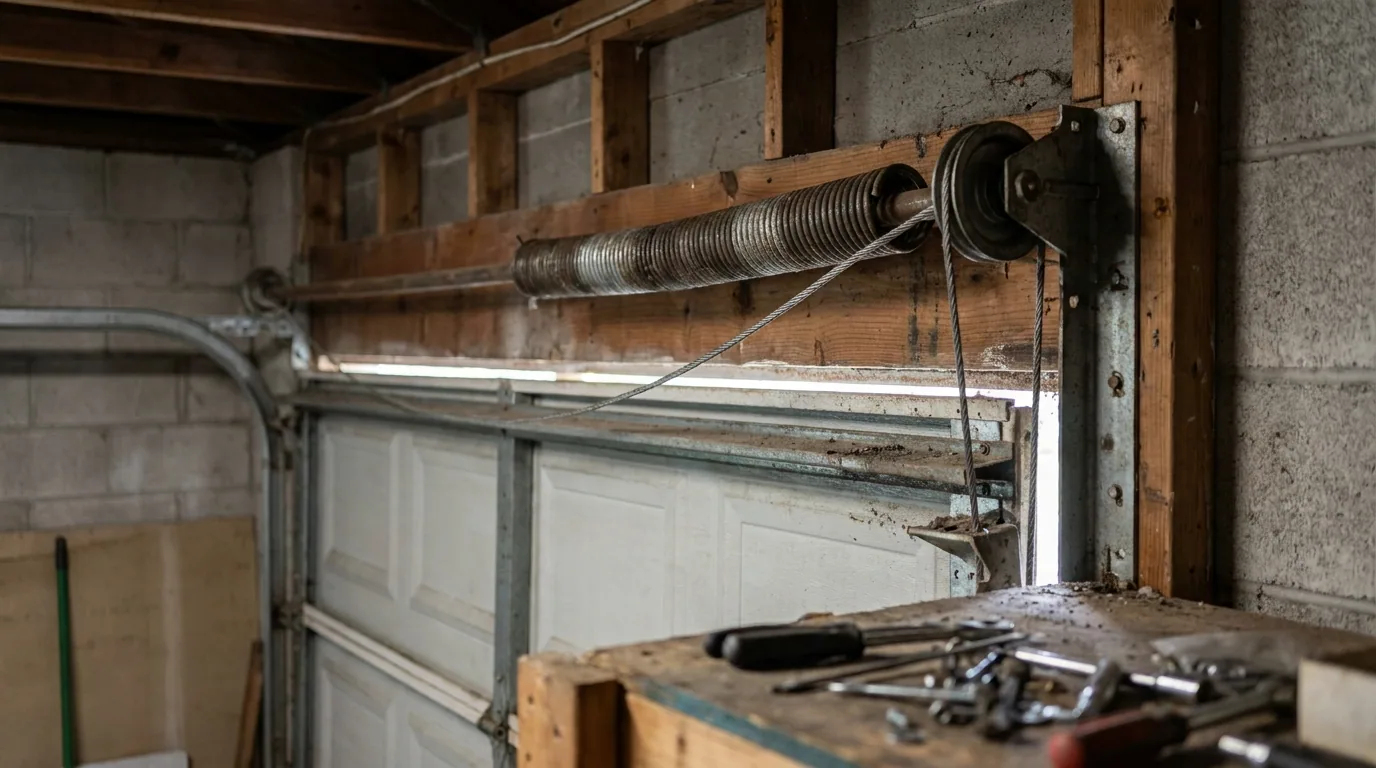
When a technician replaced a spring or a cable, the door's weight and balance changed, and the opener's force setting may now be reading the door as an obstruction. The travel limits may also have been disturbed. The technician checks the down-limit setting, the force adjustment, and the balance of the door itself, then confirms the photo-eyes are aligned and unobstructed as a separate step. If the door reverses before the floor, the limit and force settings are where the diagnosis starts.
A door that touches the floor and comes straight back up
This one has a short list of likely causes, and the test that separates them is the down-limit setting. If the opener thinks the floor is higher than it is, it reaches its programmed stop, reads resistance, and reverses. A technician checks where the limit is set relative to the actual floor, then checks whether the door is meeting something on the way down, such as a track that is out of alignment or an object in the path.
The photo-eye is worth ruling out here too, but only in its proper role: if something is blocking or misaligning the eye, the door reverses while closing. The technician confirms the eyes are aligned, clean, and unobstructed, and that the wiring was not disturbed during the repair. What separates a limit problem from an eye problem is when the reversal happens: an eye reversal occurs on the way down, while a limit reversal occurs at the floor.
A door that stops short of the floor
A door that stops an inch or two above the floor and stays there is usually a limit setting that no longer matches the door's travel, or a door that has become harder to move than the opener is set to allow. After spring or cable work, the door's balance can change enough that the opener's force setting needs to be adjusted to match. The technician checks the door's balance first, then the force and limit settings, because adjusting the opener to push a door that is binding is the wrong fix.
If the door feels heavier than usual when you use it normally, say so. That is useful information and it points the technician toward the counterbalance rather than the opener. Do not try to lift the door by hand or test its balance yourself; that is technician work and it is where people get hurt.
When the door closes but drifts back up
A door that closes, then drifts back up slightly after the opener stops is often a sign that the door is not being held firmly at the bottom, or that the opener's down-limit is set so the door reaches the floor before the opener finishes its travel. The technician checks the down-limit, the force setting, and the door's balance. If a spring was replaced, the new spring may be holding slightly more or less of the door's weight than the old one, and the opener's settings need to match the door as it now is.
This is also where a technician checks the track and rollers. A door that is binding slightly on one side can close and then be pushed back by the stored energy in the springs. The track inspection and the balance check are done together, because one can disguise the other.
What to tell the technician
Before the visit, note the behavior in the terms above, when it started relative to the repair, and whether it happens every cycle or only sometimes. Mention any new noise at the start of a cycle, and whether the door sits level when closed. If the door is visibly crooked when closed, or there is a gap along the top, say that too, since it points toward the cables or the track rather than the opener.
If you are in Fort Pierce, Port St. Lucie, Vero Beach, Stuart, Jensen Beach, Hutchinson Island, Sebastian, Palm City, Lakewood Park, or White City and your door will not stay closed after a repair, Torsion Pro Garage Doors can sort out which of these it is. The company is licensed and insured, serves the Treasure Coast of Florida, and can be reached at (561) 225-1433 or info@torsionpro.com. The address is 2603 Bennett Dr, Fort Pierce, FL 34946, with weekday hours of 7:00 AM to 7:00 PM, weekend hours of 8:00 AM to 6:00 PM, and emergency service available.