A garage door that opens crooked is one of the more useful symptoms a homeowner can bring to a technician, because it narrows the problem down before anyone arrives. A door that rises evenly is being carried by two sides that agree with each other. A door that rises with one corner low, one side lagging, or a visible tilt partway up is a door where that agreement has broken. The cause is not always the same, and the wrong guess can lead to a repair that fixes the symptom and leaves the real fault in place. Here is how the possibilities sort out, and what a technician does to separate them.
What "crooked" actually looks like
Homeowners use the word for several different behaviors, and they point to different parts of the system. The common ones:
- The door sits visibly tilted even when fully closed, with one bottom corner lower than the other.
- The door starts level but rises at an angle, one side climbing faster than the other.
- The door rises partway and then stops or reverses, sitting crooked at that point.
- The door closes crooked, meeting the floor unevenly on one side.
Each of these is worth describing to the technician in those terms. "It goes up crooked" and "it sits crooked when closed" can have different causes, and knowing which one you have saves time.
The three main causes, and how they are separated
A crooked door usually comes down to one of three things: a snapped cable, a broken torsion spring, or a bent or displaced track. None of these can be confirmed from the driveway with certainty, but a technician can separate them quickly, and the tests are mechanical rather than guesswork.
Snapped cable
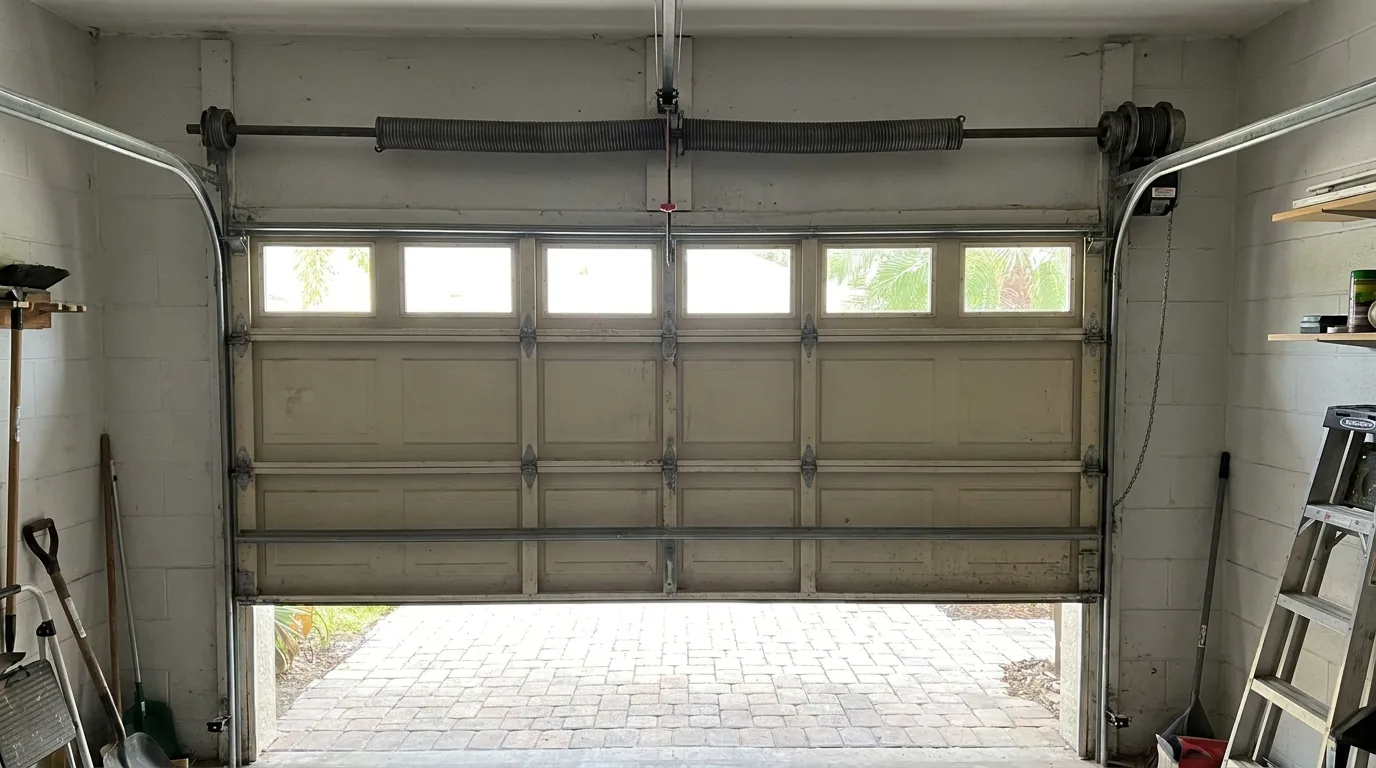
The cables run from the bottom corners of the door up through pulleys to drums at the ends of the torsion shaft. They keep the two sides of the door moving together. When one cable snaps, that side of the door loses its connection to the counterbalance, and the door hangs at an angle. A door with a snapped cable is mechanically certain to hang crooked, and it is also mechanically certain that the door should not be run until the cable is replaced. Running the opener on a door with one cable gone puts the full load on the remaining side and can walk rollers out of the track.
Broken torsion spring
On a two-spring door, one spring can break while the other stays intact. The door loses roughly half its counterbalance, and the side still being carried by the good spring rises more easily than the other. The result is a door that opens at an angle, and it will feel heavier in normal use. A single-spring door with a broken spring usually will not lift at all, but a two-spring door can still move, which is why a broken spring sometimes presents as a crooked door rather than a dead one.
Bent or displaced track
The vertical and horizontal tracks guide the rollers, and if a section is bent, dented, or knocked out of alignment, one side of the door binds while the other runs free. That produces the same tilted travel as a counterbalance fault. A track problem can also be a consequence of a cable or spring failure rather than the original cause, which is why the technician checks the counterbalance first and the track second.
The test that separates them is straightforward for a technician: confirm cable condition at both drums, confirm spring condition at the torsion shaft, then check track alignment and roller seating. A homeowner should not attempt any of those checks, because all three involve parts under tension or parts that can move suddenly.
What you can safely observe from the driveway
With the garage empty and the door operated normally from the button, you can note several things without touching any hardware:
- Whether the tilt is present when the door is fully closed or only appears during travel.
- Whether the door feels heavier than usual when you use it normally.
- Whether there is a new noise at the start of a cycle, and roughly where it seems to come from.
- Whether a gap appears along the top of the door when it is closed.
- Whether the opener runs but the door does not move, or moves only slightly.
Those observations help the technician decide what to bring and what to check first. They are not a diagnosis, and they should not be treated as one.
Why you should stop operating a crooked door
A door that opens crooked is a door under uneven load. The opener is designed to move a balanced door, not to drag one side of a heavy panel up a track while the other side resists. Continuing to run it stresses the opener's gear and drive train, wears the rollers unevenly, and can turn a single failed part into a track repair as well. If the door has stopped moving entirely, or if it moves a short distance and reverses, stop pressing the button and call for service. Torsion Pro Garage Doors handles broken spring replacement, snapped cable repair, off-track repair, and opener repair across the Treasure Coast, and the company is licensed and insured. The number is (561) 225-1433, and emergency service is available outside normal hours.
What the repair usually involves
Once the technician identifies the cause, the repair follows from it. A snapped cable means replacing the cable and checking the drum and the opposite cable for related wear. A broken spring on a two-spring door means replacing the failed spring, and the technician will discuss whether the second spring should be replaced at the same time given its age and condition. A bent track means straightening or replacing the affected section and confirming the rollers seat correctly afterward. In every case the door is balanced and cycled before it is handed back, because a repair that leaves the door running crooked has not solved the problem.
If your door is opening at an angle, describe what you see when you call. The more precisely you can say when the tilt appears and how the door behaves at the start of a cycle, the faster the technician can get to the right part of the system.