A torsion spring rarely breaks at a convenient moment. It tends to let go on the first cold morning of the year, or after a stretch of afternoons hot enough that the garage never really cools down. Homeowners on the Treasure Coast often ask whether the weather caused it. The honest answer is that the weather is usually the last straw rather than the whole story. A spring breaks when its remaining strength can no longer carry the door, and the day it happens is often just the day the margin ran out. Here is what a technician looks at, and how to tell what you are dealing with.
What a broken spring actually tells you
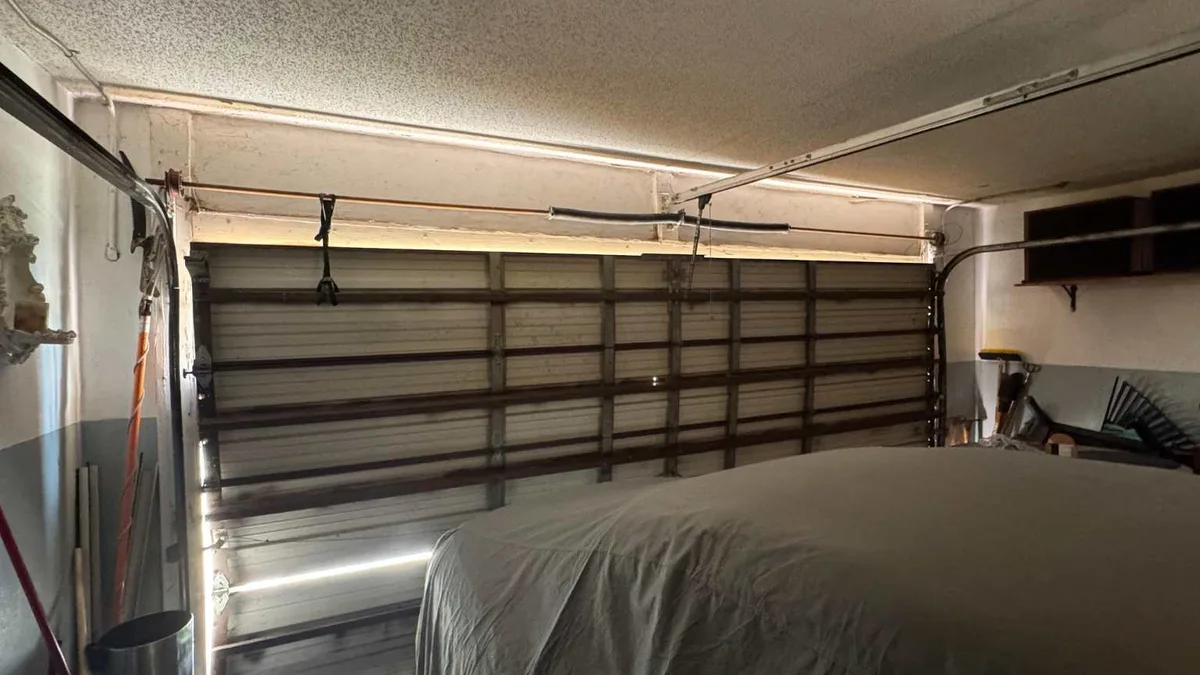
A torsion spring is a coiled steel bar mounted above the door. It stores energy as it winds and releases that energy to help lift the door. When the coil separates, the counterbalance is gone. The full weight of the door now rests on the opener, the cables, and the tracks, and none of those parts are built to carry it.
That is why a door with a broken spring behaves oddly. The opener may hum and stall. The door may come up a few inches and stop, or come down hard. A cable may jump its drum. If you hear a bang from the garage and the door will not lift, leave it closed and call for service. Do not try to open it by hand, and do not run the opener to see what happens. Both put load on parts that are already outside their design.
Why the season gets blamed
Steel under tension is affected by temperature, and a torsion spring spends its whole life under tension. A technician can describe the general behavior: metal contracts as it cools and expands as it warms, and a spring that has already lost some of its strength has less room to absorb that movement. What a technician cannot tell you from the driveway is exactly how much of your spring's remaining life was used up by a particular cold front.
So treat the weather as a trigger, not a diagnosis. The useful question is not why this week, but how much life the spring had left and what else is carrying load alongside it. On the Treasure Coast, where humid air and salt work on metal year-round, the hardware around a spring is worth inspecting at the same time. Corrosion on a cable or a drum changes how the spring's energy is delivered, and a technician will check those parts before ordering a replacement.
What the technician checks before replacing a spring
A spring replacement is not just a swap of one coil for another. The new spring has to match the weight of the door and the hardware it works with. Before ordering the part, a technician typically works through the following:
- Door weight and balance. The door is disconnected from the opener and moved by hand to see where it wants to sit. A door that will not stay put at mid-height is not balanced.
- Spring size and wind. The wire diameter, inside diameter, and length of the coil determine what the spring can lift. A mismatched spring either will not hold the door or will be overstressed from day one.
- Cables and drums. Frayed strands, a cable off its drum, or a drum that has slipped all change the load path.
- Rollers and hinges. A dry steel roller squeals on the track, and a binding roller adds resistance the spring has to overcome every cycle.
- The opener. If the door has been run on a broken spring, the opener may have taken damage. A stripped gear lets the motor run without moving the door, and that is a separate repair.
All of this work happens with the spring under tension or with the door's weight in play. It is not homeowner work. Torsion springs, cables, and the opener drive train should always go to a technician.
Signs the spring is failing before it breaks
Springs often give warning. Watch for a door that feels heavier than it used to, one that opens unevenly, or one that drifts down on its own after you let go of it. Listen for a new creak or groan during travel. None of these symptoms points to a single cause on its own. A door that is harder to lift could be a weakening spring, a binding roller, or a cable that is starting to fail, and the way to separate them is to disconnect the opener and move the door by hand while a technician watches the hardware.
If the door has stopped entirely, the diagnosis narrows. A door hanging at an angle usually means a snapped cable. A motor that runs without moving the door usually means a stripped opener gear or a disconnected arm. A door that reverses immediately after touching the floor usually means a misaligned or blocked photo-eye. Each of these is a different repair, and guessing at it from the outside costs more than checking it once.
What to do when it happens
Leave the door where it is. Do not force it, and do not keep pressing the opener button. Clear the area under the door so nothing and no one is beneath it, and call for service. Torsion Pro Garage Doors handles broken spring replacement, snapped cable repair, off-track doors, and opener repair across the Treasure Coast, and emergency service is available. The number is (561) 225-1433, and the address is 2603 Bennett Dr, Fort Pierce, FL 34946. The company is licensed and insured. A spring that breaks in a cold snap or a heat wave is usually a spring that was already near the end of its life. Getting it looked at promptly is what keeps the rest of the door's hardware out of the repair.