You heard a bang from the garage, and now the door will not lift. On most doors there are two torsion springs mounted on the shaft above the door, and the first question a technician asks is whether one let go or both. It matters, because the answer decides whether you need one spring or a pair, and because a door running on a single spring is not balanced the way it was designed to be. Here is how that question gets answered, and what you can safely check yourself before you call.
Why two springs instead of one
Two springs share the weight of the door. Each one carries roughly half the load, which is why a pair can be wound from lighter wire than a single spring doing the same job, and why the door cycles with less stress on each coil. When one spring breaks, the other is suddenly carrying the whole door on its own. That is the part homeowners tend to miss: the surviving spring is not a spare. It is a part that has been working alongside the broken one for the same number of cycles, and it is now doing double the work it was sized for.
What you can see and hear from the floor
You do not need to climb a ladder or touch the springs to gather useful information. Stay on the floor and look at the door and the hardware from a safe distance.
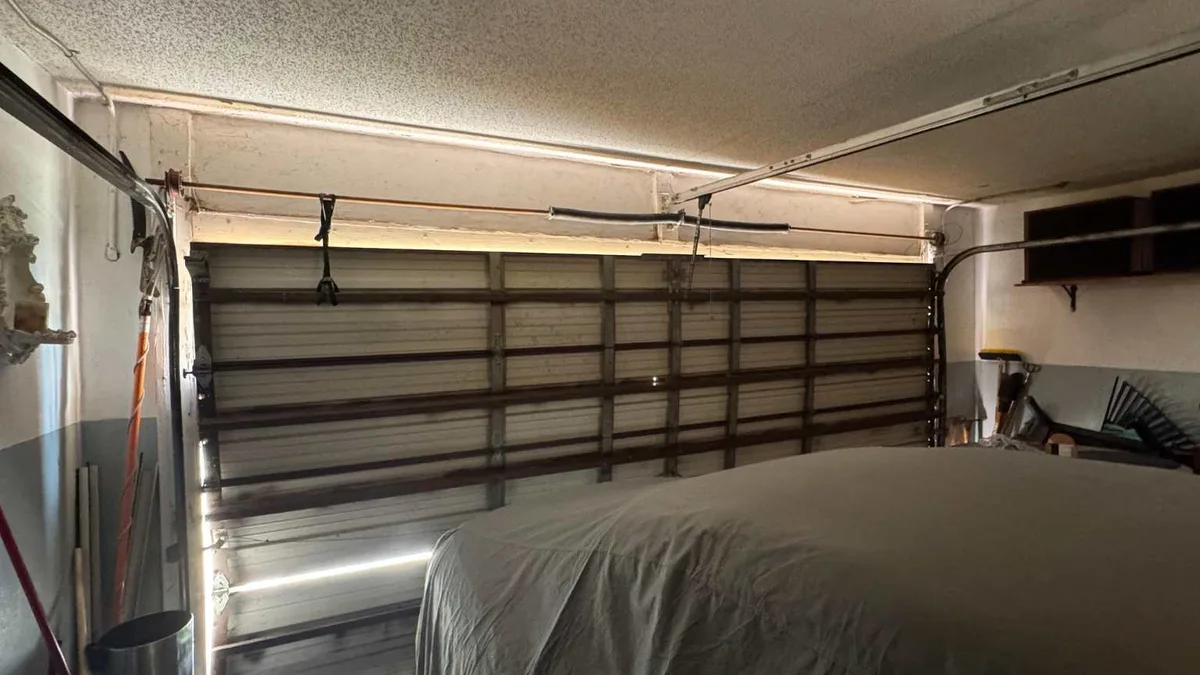
- A visible gap in the coil. On many installations the springs sit above the door where you can see them from the floor with the door closed. A broken spring shows a clean separation in the coil, often a gap of an inch or more. Look at both springs in turn.
- The door hangs at an angle. If the door comes up crooked, or one side lifts while the other lags, the counterbalance is uneven. That points to one side losing its spring.
- The opener strains or stalls. A door with no counterbalance puts its full weight on the opener, which is not built to lift it. The motor may hum and give up, or the door may rise a few inches and stop.
- A single loud bang, or two. One sharp report is typical of one spring letting go. Two bangs close together can mean both went, though the sound is not reliable enough on its own to settle the question.
What you should not do is try to open the door by hand to test it, or run the opener repeatedly to see what happens. With the counterbalance compromised, the door's weight is resting on the cables, the tracks, and the opener, and none of those parts are designed to carry it. Leave the door where it is and call for service.
What the technician checks that you cannot
The visible gap is only half the diagnosis. A technician confirms the condition of both springs directly, and checks the parts that a failure puts under strain.
The surviving spring is examined for its own condition, not just for whether it is intact. A spring that has been overloaded can show signs of distress that are not obvious from the floor. The technician also looks at the cables and drums, because a spring failure can let a cable jump its drum or come off under slack, and a cable that has jumped is a separate hazard from the spring itself.
The door is then checked for balance. With the springs disengaged, the door should hold position partway open rather than drifting down or running up. If it does not, the spring setup is not matched to the door, and that has to be corrected when the replacement goes on, not after.
Separating a broken spring from a snapped cable
These two failures can look alike from the driveway, and they call for different work. A snapped cable usually leaves the door hanging at an angle, with one corner dropped and the door twisted in its tracks. The spring may be perfectly intact. A broken spring, by contrast, leaves the door level but too heavy to lift, because the counterbalance is gone evenly on both sides or the surviving spring cannot carry the load alone.
If the door is crooked, suspect a cable. If it is level but immovable, suspect a spring. If it is crooked and you can also see a gap in a coil, you may have both, and the technician will confirm which came first.
Why the second spring usually gets replaced too
When one spring of a matched pair breaks, the usual practice is to replace both. The reasoning is straightforward: the two springs were installed together, wound together, and have cycled the same number of times. The surviving one is at the end of the same service life as the one that failed, and it is now carrying a load it was never sized for. Replacing only the broken spring leaves a door balanced by one new part and one aged one, and the aged one is the next thing to let go.
That is a recommendation, not a rule, and it depends on what the technician finds when both springs are inspected. What matters is that the decision is made after looking at both, rather than after looking at the one that visibly failed. If your door is stuck on the Treasure Coast, Torsion Pro Garage Doors can inspect the springs, cables, and balance and tell you what you are actually dealing with. Call (561) 225-1433 or email info@torsionpro.com.