A garage door that jerks on the way up is not just annoying. The shudder is the door telling you that something in the system is no longer moving smoothly, and the cause is usually one of a handful of parts that a technician can separate with a few checks. The important thing to understand first is that a jerking door has several possible causes, and none of them can be confirmed from the driver's seat of your car. What you can do is notice when the jerk happens, whether it is worse at a particular point in the travel, and whether anything else has changed. Those observations shorten the diagnosis considerably.
What the jerk actually tells you
A door that rises smoothly is a door whose springs are balancing its weight, whose cables are pulling evenly on both sides, and whose rollers are tracking cleanly in the rails. When one of those three stops cooperating, the door's motion becomes uneven, and you feel or hear it as a jerk, a shudder, or a series of small catches.
The location of the jerk matters. A door that jerks at the very start of the cycle, before it has traveled a foot, points toward the opener, the springs, or the initial breakaway from the floor. A door that rises cleanly and then jerks partway up points more toward the track, a roller, or a cable. A door that jerks throughout the whole travel is more likely to have a balance problem that affects every inch of the run. None of these are certainties on their own, but they tell a technician where to start.
Springs and balance
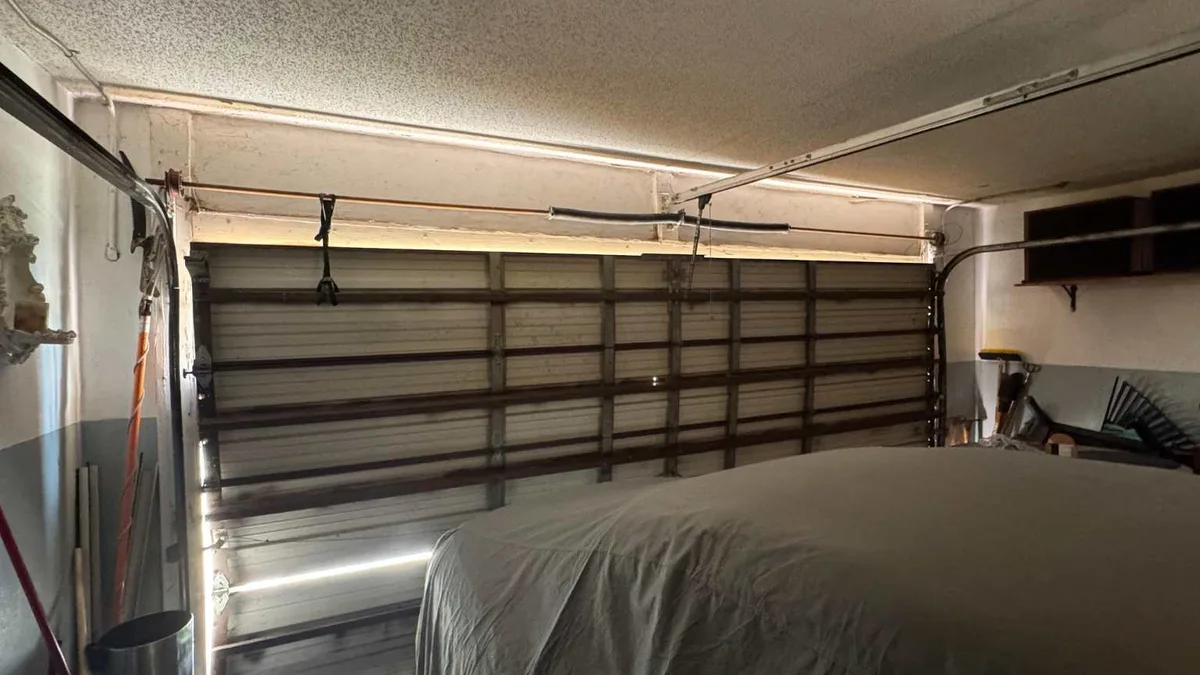
The torsion springs above the door carry most of its weight. When they are doing their job, the opener only has to guide the door, not lift it. When a spring has lost tension or has broken, the door suddenly feels heavier in normal use, and the opener works harder than it was designed to. That extra load often shows up as a jerky, labored rise rather than a clean one.
A broken spring is mechanically certain: it cannot hold the door's weight, and the door will not lift normally. A spring that is intact but has weakened is harder to spot from outside, because there is no visible break. What a homeowner can notice is that the door feels heavier when operated normally, that the opener strains or sounds different, or that the door hesitates at the start of a cycle. A technician confirms spring condition and balance directly, and that check comes before anything else, because adjusting an opener to compensate for a weak spring only masks the problem.
Cables, tracks, and rollers
A snapped cable is also mechanically certain in its effect: the door hangs at an angle, because one side is no longer being pulled. If your door rises crooked as well as jerky, a cable is one of the leading possibilities, along with a broken spring and a bent track. A technician separates these by checking cable tension on both sides, the condition of the drums at the ends of the shaft, and whether the rails are straight and parallel.
Rollers and hinges are the quieter culprits. A roller with a worn bearing, a hinge that has lost lubrication, or a roller that has jumped slightly out of the track can produce a catch at one specific point in the travel. This is often the cause when the jerk is repeatable at the same height every time. A bent track produces a similar symptom, and the two are separated by running the door and watching where the roller meets the rail.
When the opener is involved
Not every jerk comes from the door itself. A stripped gear in the opener lets the motor run without moving the door, which usually shows up as a motor sound with no movement rather than a jerk. More relevant here is the opener's force setting and travel limit. If those are set wrong, the opener can pull unevenly or stop and start, and the door responds with a lurch. A technician checks the opener's settings against the door's actual travel and confirms the motor is moving the door the way it should.
One thing worth knowing: the photo-eye is a safety device on the closing travel only. A blocked or misaligned photo-eye reverses a door that is closing, and it plays no part in a door that jerks on the way up. If your door reverses before it reaches the floor, that is a travel-limit or force-setting issue, not the photo-eye.
What to note before you call
You do not need to diagnose the door yourself, and you should not try to. Torsion springs, cables, and the opener drive train are technician work, and the safest thing a homeowner can do is leave them alone. What helps is a clear description: when the jerk starts, whether it happens at the same height each time, whether the door looks crooked from outside, whether it feels heavier than it used to, and whether there is a new noise at the start of the cycle.
If you are on the Treasure Coast and your door has started to jerk, Torsion Pro Garage Doors works on springs, cables, tracks, and openers across Fort Pierce, Port St. Lucie, Vero Beach, Stuart, Jensen Beach, Hutchinson Island, Sebastian, Palm City, Lakewood Park, and White City. The company is licensed and insured, and emergency service is available. Call (561) 225-1433 or email info@torsionpro.com to describe what you are hearing and set up a visit.