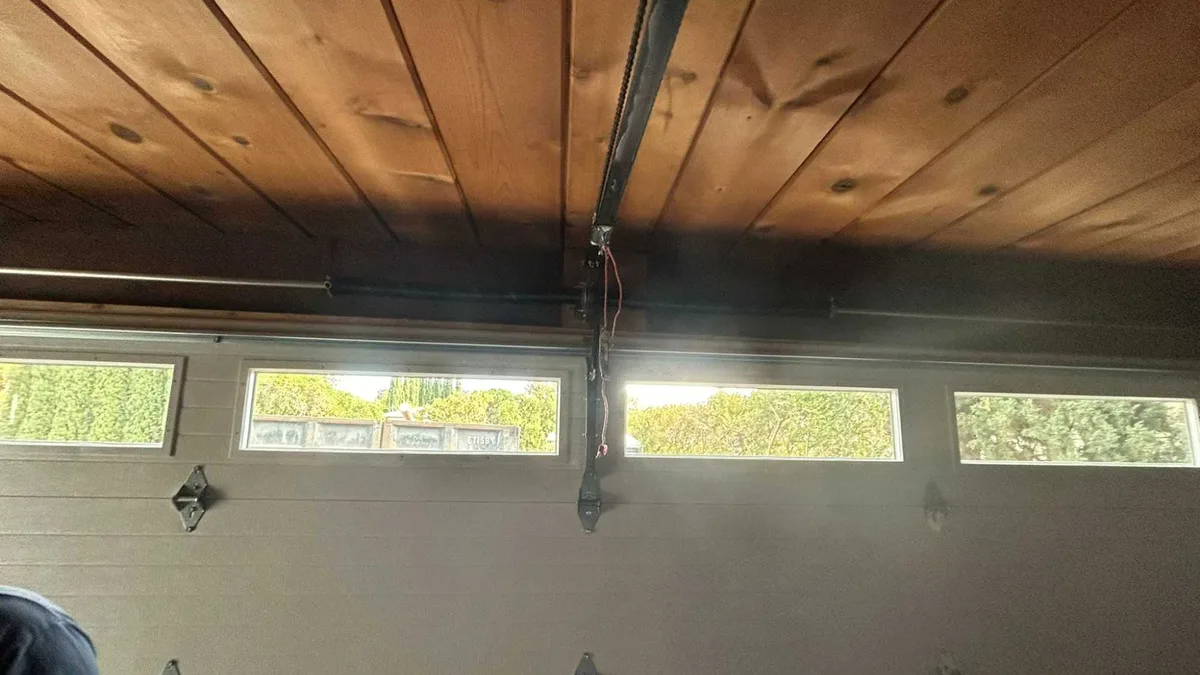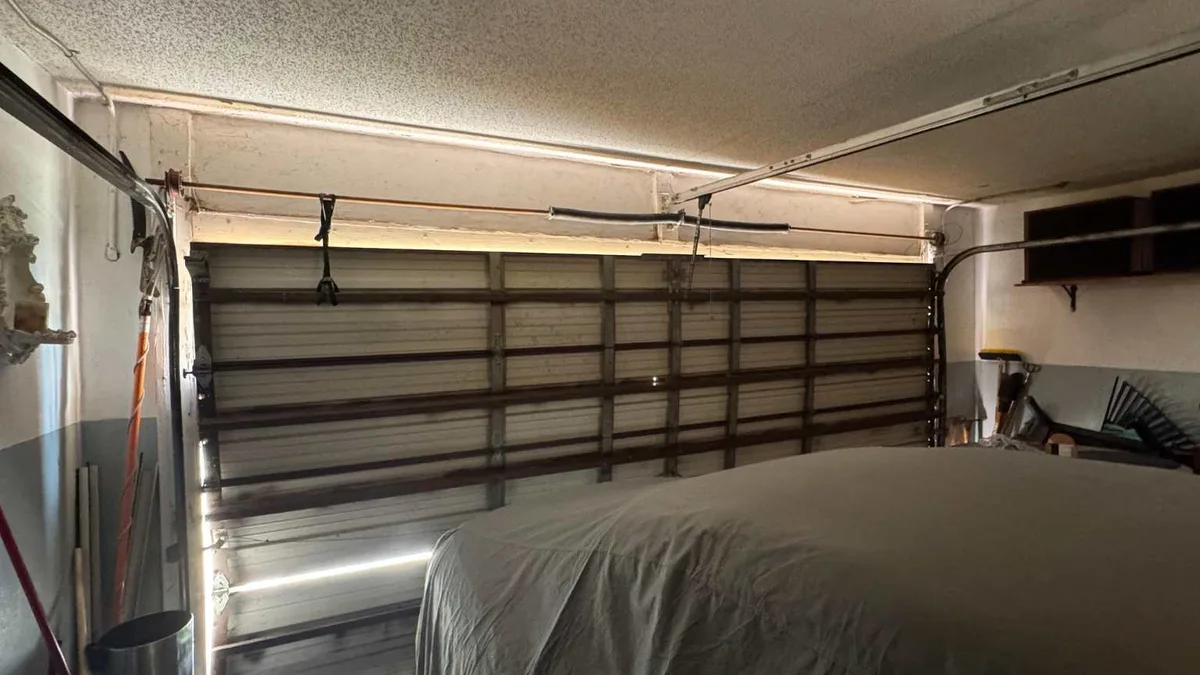
A broken torsion spring and a door that has left its tracks often get reported as two separate problems, but they are usually one event with two visible results. The spring lets go, the door loses the counterbalance that was holding it, and the weight and the uneven pull that follow can walk a roller out of the track. What a homeowner sees is a door hanging at an angle, jammed partway, or sitting with one side low. Understanding the sequence matters, because the fix is not just putting the door back on the track. If the spring is not addressed, the door will come off again.
What the spring was doing before it broke
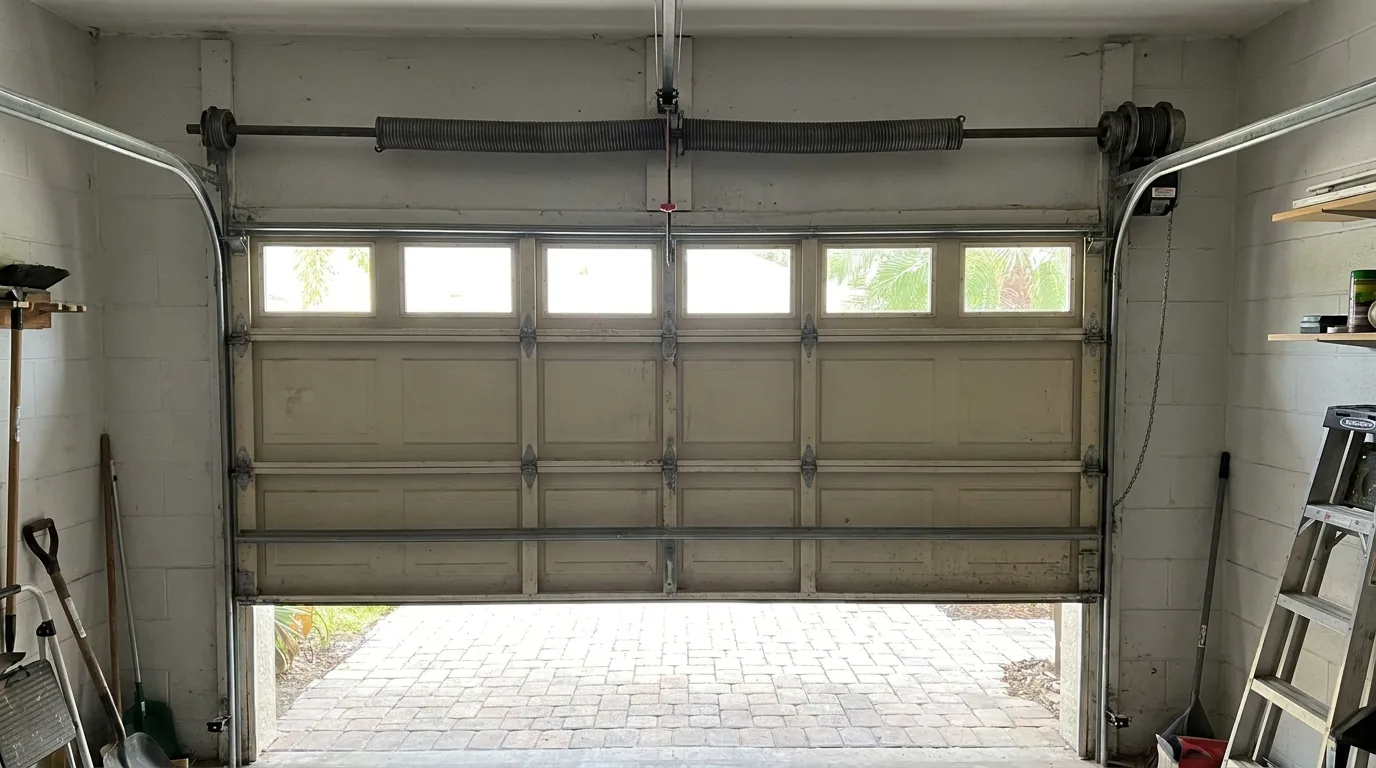
A torsion spring is wound during installation so it stores energy, and that stored energy carries most of the door's weight through the travel. The opener starts the door moving and controls the speed, but it is not designed to hold up a door on its own. When the spring is intact, the door is balanced: the two sides of the door travel together, the rollers sit evenly in the track, and the opener only has to overcome friction and inertia.
When a torsion spring breaks, that balance is gone. The door is now a heavy panel hanging on a shaft with nothing counteracting its weight. A door with a single broken spring on a two-spring setup will behave differently from a door whose only spring has failed, but in both cases the door is no longer being carried the way it was designed to be.
How the door leaves the track
The track is a guide, not a clamp. Rollers sit inside it with some clearance, and they stay in place because the door is moving evenly and the panels are aligned. Once the spring fails, several things can push a roller past the edge of the track or bend the track itself:
- Uneven lift. With the counterbalance gone on one side, the door rises or falls at an angle. A panel that is not square to the track can catch a roller and lever it out.
- Dropping under its own weight. If the door is partly open when the spring breaks, the full weight can come down on one side faster than the other, and the jolt can jump a roller or flex the track.
- The opener still trying. A motor that keeps running against a door it cannot lift puts force into the wrong places. The arm can pull the top panel out of line, and the door can twist in the track.
- A pre-existing bend. A track that was already slightly out of alignment or a roller that was already worn can be the point where the door gives way once the spring is gone.
This is why a technician treats a door off its track and a broken spring as one job. Straightening the track and reseating the rollers without replacing the spring leaves the door unbalanced, and it will not stay in the track.
What the technician checks, and in what order
The first thing a technician confirms is the state of the springs and cables, because those determine whether the door can be moved safely at all. The technician inspects the springs on the shaft above the door and the cables that run down each side, looking for a break, a gap in the coil, or a cable that has come loose from its drum. A door with a snapped cable hangs at an angle, and that alone can look like a track problem from the floor.
Only once the spring and cable condition is known does the track get assessed. The technician checks whether the track is bent, whether the rollers are seated, and whether the panels are still square to each other. A door that has been sitting crooked under load can have a bent section of track, a bent hinge, or a panel that has twisted, and those are different repairs.
From outside the door with the garage empty, a homeowner can note what the door is doing without touching any of it: the door sitting crooked in the opening, a gap along the top, the door feeling heavier than usual when it is used, or a new noise at the start of a cycle. Those observations help the technician before the visit, but they do not replace the inspection.
Why the door should be left alone until it is repaired
A door that is off its track with a failed spring is under load in ways it was never meant to be. Running the opener again can bend the track further, twist a panel, or pull the door down unevenly. Trying to straighten the track or force the door back into place by hand is the kind of work that belongs to a technician, because the door can move suddenly when the remaining tension releases.
The safe course is to stop operating the door, keep the area under it clear, and have it looked at. Torsion Pro Garage Doors handles broken spring replacement, snapped cable repair, and off-track repair across the Treasure Coast, and the work starts with the spring and cable inspection that tells the technician what the door needs. The phone number is (561) 225-1433, and the shop is at 2603 Bennett Dr, Fort Pierce, FL 34946.
The short version
A spring breaks, the door loses its counterbalance, and the resulting uneven travel or sudden drop is what pushes a roller out of the track or bends it. The track is the visible damage; the spring is the cause. Repairing the track without restoring the balance puts the door back in a position to come off again, which is why the two are handled together.