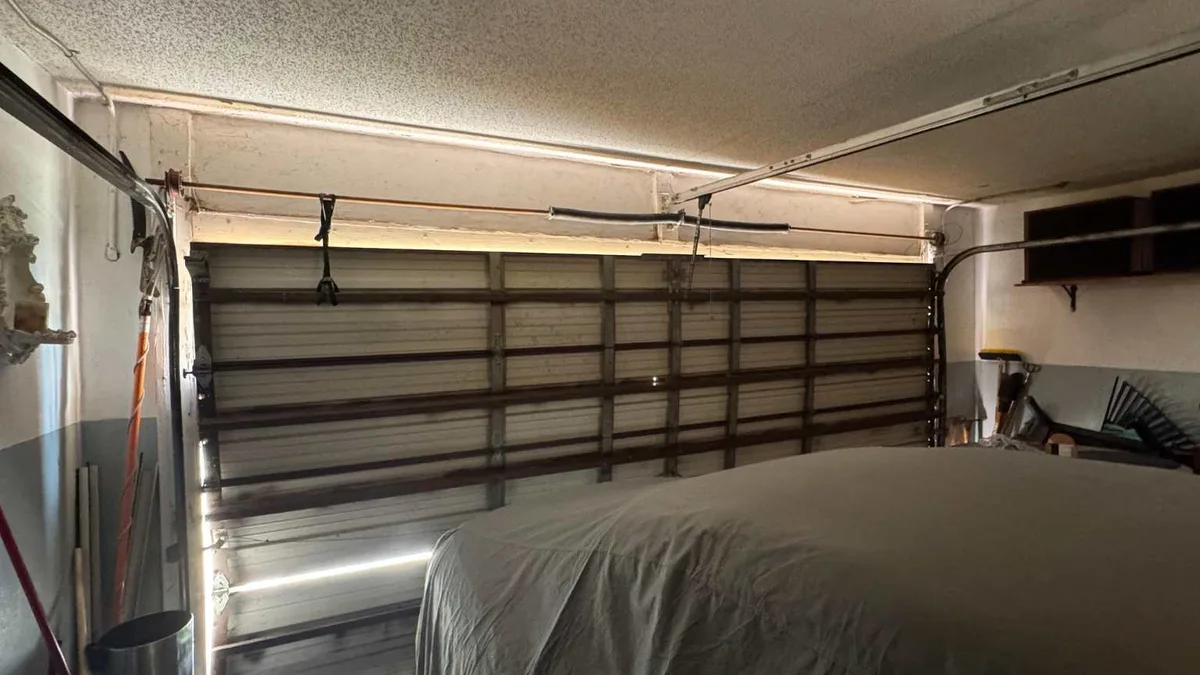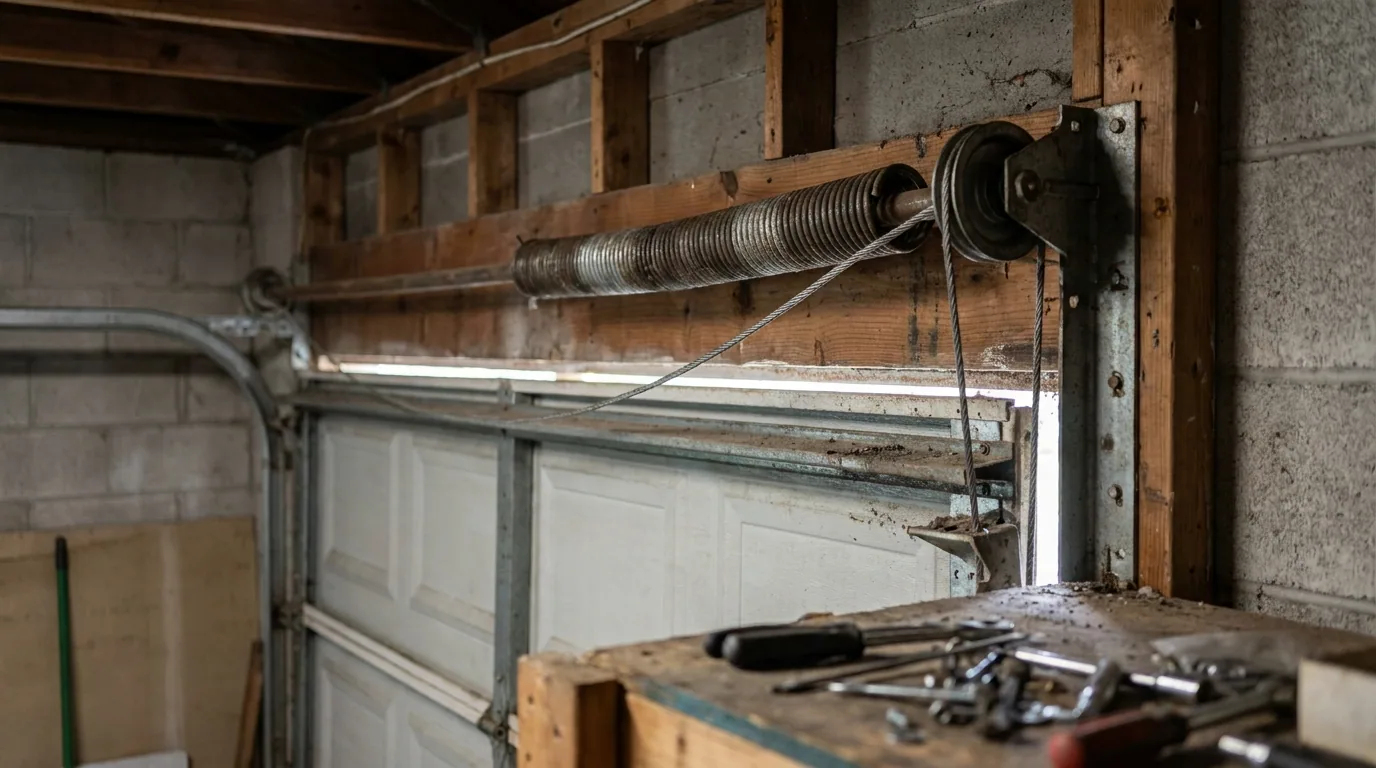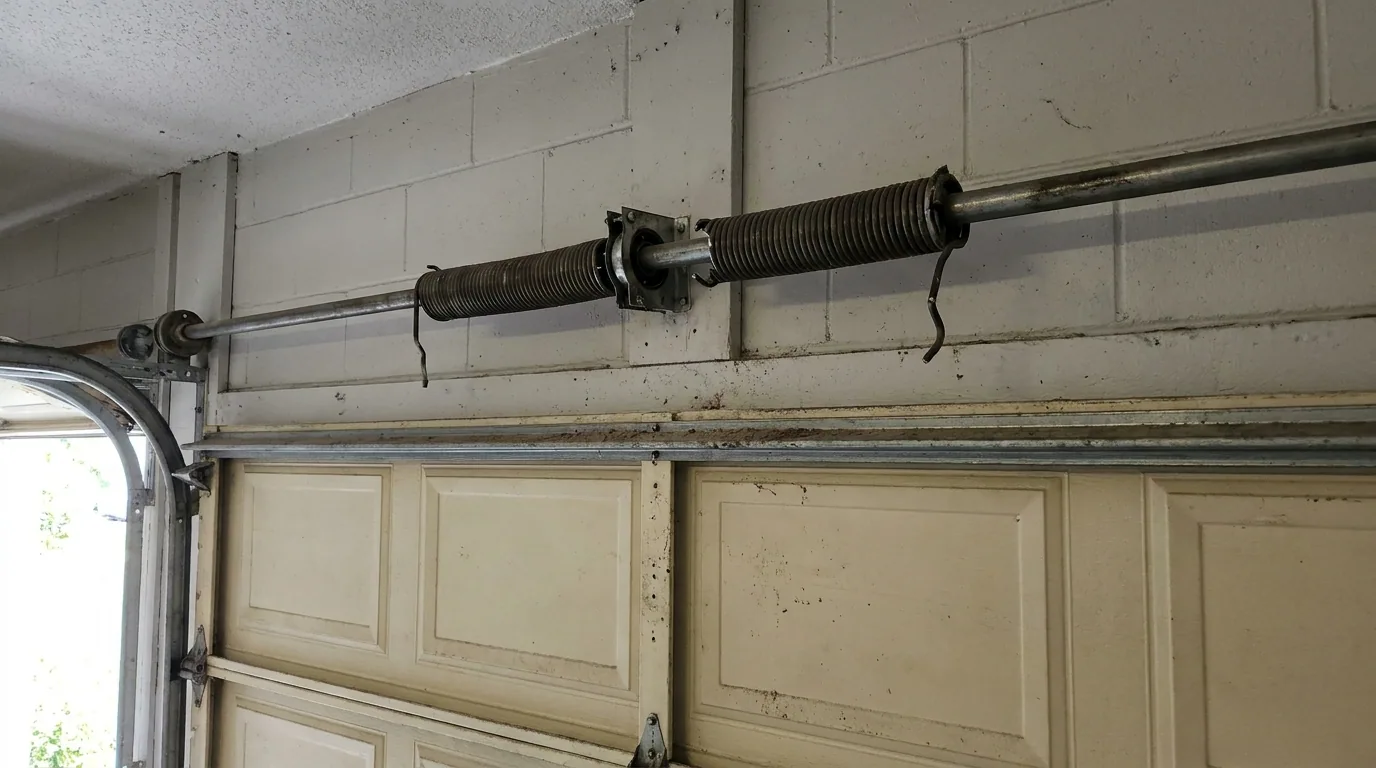
A garage door tune-up is often sold as maintenance, and homeowners tend to think of it the way they think of an oil change: something you do on a schedule because the manual says so. That undersells what a tune-up actually does on a torsion system. The springs above the door are holding most of the door's weight every hour of the day, and a handful of small conditions decide whether they last as long as they should or fail early. A tune-up is the appointment where those conditions get found. It does not make an old spring new, and it cannot promise a spring will never break, but it can catch the things that quietly push a spring toward failure and correct them before the spring is the part that tells you.
What a spring failure actually looks like
When a torsion spring breaks, the door loses the force that balances its weight. The door will not lift normally, and if it was partway up when the spring let go, it comes down hard. The break itself is usually a clean separation in the coil, and it often happens while the door is sitting still rather than mid-cycle, which is why people describe hearing a loud bang from the garage with no one near it.
A broken spring is mechanically certain as a cause of a door that will not lift or that feels far heavier than it should in normal use. That certainty is about the diagnosis after the fact. The question a tune-up addresses is different: what was happening to that spring in the months before it broke?
The conditions a technician checks that shorten spring life
A torsion spring is a steel coil under tension. It is designed to cycle a certain number of times, and every open and close counts as a cycle. Nothing changes that math. What a tune-up looks at is whether the system is asking the spring to do more work than it should, or working against it.
Balance
A door that is properly balanced needs very little force from the opener to move, because the springs are carrying the weight. A door that has drifted out of balance asks the opener, and the springs, to compensate. The technician checks balance as part of the tune-up, and correcting it is technician work. A homeowner should not test balance by hand or lift the door to feel its weight, because a door with a compromised spring or cable can come down on someone doing exactly that.
Track alignment and roller condition
If the track is out of line or a roller is worn flat, the door drags as it travels. That drag is resistance the springs and opener have to overcome on every cycle. A technician checks the track for alignment and the rollers for wear, and replaces what is worn.
Fasteners and the torsion hardware
The springs are anchored at the center bearing plate and wound on a shaft held by drums at each end. Loose set screws, a shifting center plate, or hardware that has worked loose lets the assembly move in ways it was not designed to. The technician tightens and checks these connections during a tune-up.
Lubrication
Springs, hinges, rollers, and bearings need lubrication, and dry metal wears faster than lubricated metal. This is one of the simplest parts of a tune-up and one of the most consistently skipped by homeowners.
What you can notice from outside the door
You do not need to inspect the springs or cables to know something has changed. With the garage empty and the door closed, these are the observations worth writing down before you call:
- The door sits crooked in the opening, with one side higher than the other.
- There is a gap along the top of the door where there used to be none.
- The door feels heavier than it used to when you operate it normally from the wall control.
- There is a new noise at the start of a cycle, or a hesitation before the door moves.
- The door opens a little and then stops or reverses.
None of these points to one part on its own. A crooked door can mean a snapped cable, a broken spring, or a bent track, and the technician separates those by checking each. A noise at the start of a cycle can come from a roller, a hinge, or a dry bearing. Describing the symptom precisely is more useful than guessing at the cause.
Why the tune-up is not a guarantee
It is worth being clear about what a tune-up can and cannot do. A spring that has already been cycled close to its rated life is going to fail, and no amount of lubrication or adjustment changes that. What a tune-up does is remove the avoidable wear: the drag from a misaligned track, the extra load from an unbalanced door, the friction from dry hardware. It also puts a technician's eyes on the springs and cables, which is the only safe way those parts get inspected.
If a technician finds a spring that is showing the signs of nearing the end of its life, that is information you can act on before the door comes down on its own schedule. The same applies to a cable with worn strands or a drum that has started to slip.
When to call rather than wait for the next tune-up
A tune-up is for a door that is working. A door that will not lift, that has come off its track, that hangs at an angle, or that made a loud bang and now behaves differently is a repair call, not maintenance. Keep people and vehicles clear of the door, leave the opener alone, and call a technician. Torsion Pro Garage Doors serves the Treasure Coast and can be reached at (561) 225-1433 or info@torsionpro.com, with emergency service available. The company is licensed and insured.